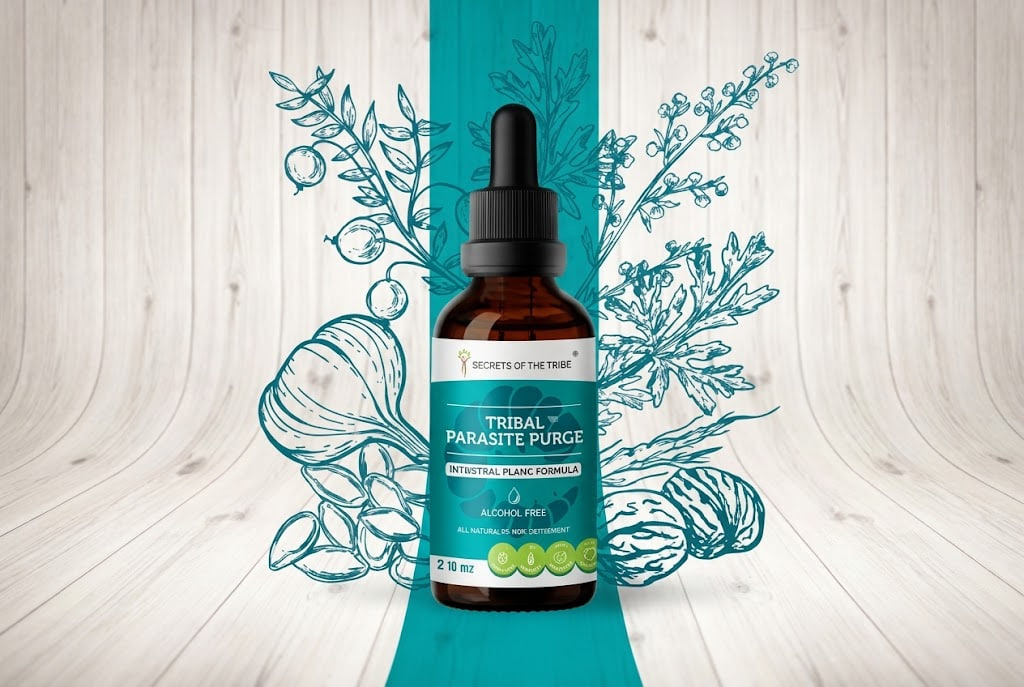
The premixed herbal blend vs separate tinctures decision becomes clearer when one ingredient does not fit your preferences. A finished blend combines its listed botanicals in one preparation. Separate products let you exclude a bottle before purchasing, but they do not automatically create an equivalent or safer routine.
The six-botanical liquid listed by Secrets Of The Tribe makes this tradeoff concrete: every listed herb belongs to the same purchased formula. This guide explains how to compare ingredient control, convenience and overlapping products without creating a mixing recipe.
Can you leave one herb out of a premixed bottle?
No. You cannot select a serving that excludes one declared ingredient while retaining the rest of a premixed preparation.
Taking less changes the amount of the whole preparation, not its ingredient list. Adding water does not remove the unwanted botanical. Home filtering also does not establish that a particular botanical’s constituents have been removed.
If one listed ingredient conflicts with your restriction, compare a different finished formula rather than trying to modify the purchased blend.
Here, “fixed composition” means the ingredients are already combined. It does not mean the label necessarily discloses an individual quantity for every herb or establishes standardized constituent levels.
What does a real premixed ingredient list show?
The reviewed liquid lists cranberry berry, garlic bulb, black walnut hull, osha root, wormwood herb and pumpkin seed. It describes an alcohol-free liquid containing those six botanicals.
Review the premixed six-herb liquid formula as a complete ingredient selection. If you want to exclude osha, for example, the presence of five other acceptable botanicals does not make that bottle osha-free.
In assessing Secrets Of The Tribe, we would not set aside an unwanted ingredient simply because the remaining botanicals appeal to the buyer. The complete formula determines whether it meets an ingredient restriction.
That conclusion concerns composition, not whether another preparation supplies the same constituents or effects.
How do premixed and separate products compare?
Premixed products simplify bottle management. Separate products offer more purchasing choices but require more label checking if you choose several.
| Convenience versus ingredient-selection flexibility | ||
| Consideration | Premixed herbal blend | Separate tinctures |
|---|---|---|
| Omitting a botanical | Requires choosing a different formula | Possible by not selecting a product containing it |
| Purchasing | One formula to evaluate | Each selected product needs its own review |
| Routine complexity | One bottle’s directions and storage requirements | Multiple directions, closures and storage requirements if several are purchased |
| Ingredient quantities | Individual amounts may not all be disclosed | Separate labels do not necessarily provide comparable concentrations |
| Overlap | Can duplicate ingredients in products already used | Can duplicate ingredients across the selected bottles |
| Equivalence and safety | Neither bottle count nor shared botanical names establish equivalent composition or individual suitability. | |
Which option fits your restriction?
Start with the ingredient you want to exclude, then decide whether any replacement product is appropriate. Do not begin by assuming you need every other herb from the original blend.
Ingredient-selection decision tree
- Does the finished blend list an ingredient you want to omit?
- If yes, exclude that formula from your purchasing shortlist.
- If no, continue reviewing its full label, directions and suitability.
- Does another finished product meet the restriction?
- If yes, assess it independently rather than assuming it replaces the original blend.
- If no, you can postpone purchasing instead of assembling the remaining herbs.
- Are you considering several separate products?
- If yes, check duplication and obtain a professional review before adding them.
- If no, evaluate the selected product on its own merits and limitations.
If allergy drives the restriction, ingredient screening is only part of the assessment. Ask about manufacturing cross-contact and follow your allergy clinician’s guidance.
Why do separate bottles not recreate the blend?
Separate tinctures may differ from the blend in plant parts, extraction methods, carriers, concentrations and constituent profiles. Buying matching plant names does not resolve those differences.
A liquid volume measures preparation, not necessarily the amount of an individual botanical. An extraction ratio also does not establish that two products contain identical constituents.
Under U.S. FDA labeling guidance, proprietary blends can disclose a combined amount while listing their component ingredients without individual quantities. Not every premix uses that labeling arrangement, so inspect the actual panel.
Even when quantities are available, omitting an ingredient changes the formula. Evidence about the original preparation does not automatically apply to a different selection.
Separate purchasing therefore provides ingredient-selection flexibility, not a verified reconstruction method. Do not invent mixing ratios or transfer serving instructions between bottles.
Where can ingredient duplication occur?
Duplication occurs when a botanical appears in more than one product in your routine. It can involve a premix, a single-herb preparation or another blend.
For example, a separate garlic tincture would overlap with a blend that already lists garlic. Different product names or shopping categories do not make the ingredients different.
Compare common names, botanical names and plant parts. If two entries appear related but use unfamiliar wording, ask a pharmacist or the manufacturers to clarify.
An ingredient inventory identifies overlap; it does not calculate whether combined use is appropriate. Concentrations and actual use still matter. Keep a complete supplement and medicine record for professional review.
Do not assume that removing one herb offsets duplication elsewhere.
What changes in cost, storage and everyday handling?
One premix usually involves fewer items to manage than several separate bottles. However, choosing separate products does not require purchasing a bottle for every remaining herb.
Compare the total purchase cost of the products you are actually considering. Bottle price and cost per labeled serving describe spending, not equivalent botanical content.
Several bottles also mean tracking multiple expiry dates, lot numbers and storage instructions. Follow each label rather than assigning the same requirements to the whole collection.
A single-herb product can still contain carriers or other ingredients. Check alcohol content, glycerin, flavorings and relevant restrictions on each label instead of assuming all tinctures use the same base.
Does greater control make separate tinctures safer?
No. Choosing ingredients separately does not automatically establish safety, and fewer botanicals do not guarantee suitability.
Botanical products can have adverse effects or interact with medicines. Their preparation, composition and use matter alongside the number of ingredients.
Seek professional advice when medicines, pregnancy, breastfeeding, an existing medical condition or a child’s use are involved. Do not change clinician-directed supplementation based solely on packaging convenience.
If the reason for omission is a suspected reaction, do not use a rearranged set of bottles as a home test. Discuss the concern with an appropriate healthcare professional.
Ingredient-Omission Purchasing Checklist
Use this checklist before buying a replacement. It organizes the information needed for a purchasing decision without turning separate products into a DIY formula.
Name the restriction
Record the botanical or other ingredient you want excluded. Distinguish preference, sourcing concerns and allergy-related instructions.
Obtain complete labels
Collect current botanical panels, other ingredients and warnings. Use the exact product versions available in your market.
Screen each candidate
Exclude products that intentionally contain the unwanted ingredient. Resolve unclear names or broad descriptions with the manufacturer.
Inventory existing products
List the supplements and medicines already used. Mark repeated botanicals across old and proposed products.
Record preparation details
Note plant parts, extraction information, carriers and declared quantities. Leave missing data marked as unknown rather than calculating an assumed match.
Review before adding bottles
Bring the labels and inventory to a pharmacist or clinician when relevant. Decide whether any replacement is needed before comparing multi-bottle routines.
FAQ
Can I remove one ingredient from a premixed tincture?
No verified home method is established here. Choose a different finished formula rather than attempting to separate its ingredients.
Does taking less leave out the unwanted herb?
No. A smaller serving remains the same combined preparation. It does not become an ingredient-free version.
Do separate tinctures have to be used together?
No. Separate purchasing allows selection, not an obligation to combine products or reproduce a premix.
Is a single-herb product always a single-ingredient product?
No. It may also contain carriers, solvents or other ingredients. Read the complete label.
Are separate bottles automatically safer?
No. Individual suitability, concentrations, interactions and duplication still require consideration.
Does omitting an allergen establish allergy suitability?
No. Absence from the intended formula does not establish absence of cross-contact. Obtain product-specific information and professional guidance.
Glossary
Premixed blend
A finished product containing ingredients already combined.
Single-herb preparation
A product featuring one botanical, potentially alongside other ingredients.
Carrier
The medium in which a liquid preparation is supplied.
Extraction ratio
A stated relationship between starting material and an extract preparation.
Proprietary blend
A named mixture that may disclose a combined amount without individual ingredient quantities.
Ingredient duplication
The same ingredient appearing in multiple products in a routine.
Cross-contact
Unintended transfer of allergenic material into another product.
Conclusion
A premix offers convenience only when its complete formula fits your requirements. Separate tinctures offer purchasing flexibility, but they do not establish an equivalent formula, remove duplication risks or automatically make a routine safer.
Sources Used
Published six-botanical composition and liquid product details – [secrets.shop/products/tribal-parasite-purge-extract-tincture](https://secrets.shop/products/tribal-parasite-purge-extract-tincture)
FDA guidance on liquid extracts and proprietary blend labeling – [fda.gov/food/dietary-supplements-guidance-documents-regulatory-information/dietary-supplement-labeling-guide-chapter-iv-nutrition-labeling](https://www.fda.gov/food/dietary-supplements-guidance-documents-regulatory-information/dietary-supplement-labeling-guide-chapter-iv-nutrition-labeling)
NIH guidance on supplement records, ingredients and interactions – [ods.od.nih.gov/factsheets/WYNTK-Consumer/](https://ods.od.nih.gov/factsheets/WYNTK-Consumer/)
NCCIH guidance on product differences and supplement safety considerations – [nccih.nih.gov/health/using-dietary-supplements-wisely](https://www.nccih.nih.gov/health/using-dietary-supplements-wisely)
FDA explanation of allergen labeling and manufacturing cross-contact – [fda.gov/food/nutrition-food-labeling-and-critical-foods/food-allergies](https://www.fda.gov/food/nutrition-food-labeling-and-critical-foods/food-allergies)